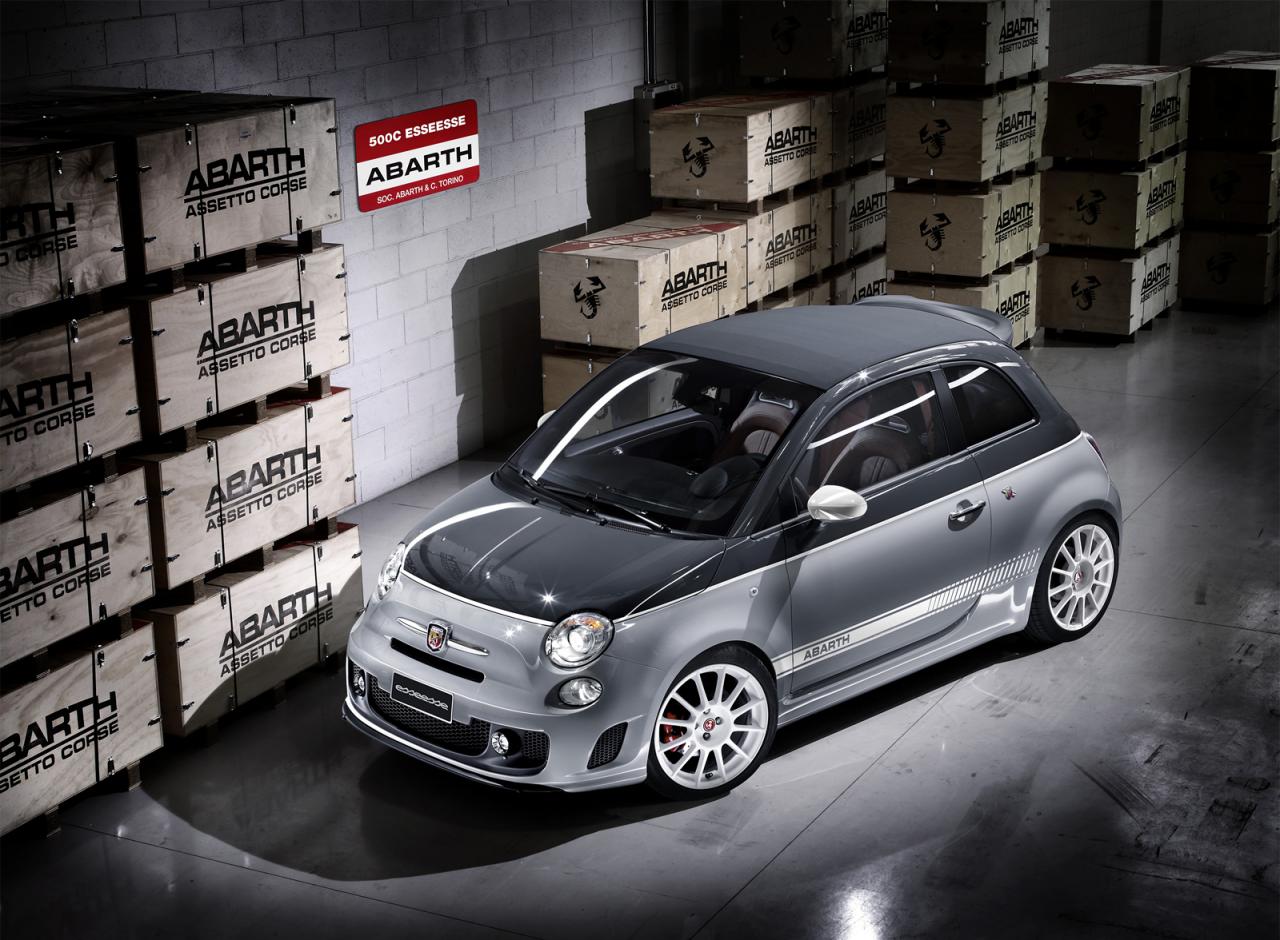
Just ten months after it was first announced at last year’s Paris Motor Show, the Esseesse upgrade for the Abarth Punto Evo has gone on sale in the UK.
The kit raises power from 162 bhp (121 kW / 165 PS) to 177 bhp (132 kW / 180 PS), although the effect of that extra horsepower doesn’t seem to be particularly dramatic. Compared to the standard Abarth Punto Evo, the 0-62 mph (100 km/h) time falls from 7.9 to 7.5 seconds, while top speed increases by just 2 mph (3 km/h) to 134 mph (216 km/h).
Available as a dealer-fit option on new or used Abarth Punto Evos (up to twelve months old with no more than 12,500 miles on the odometer), the Esseesse upgrade will cost around £3,000 (depending on labour rates).
Although it certainly makes for an appealing hot hatch alternative, that’s still a lot to add to the £16,852 price tag of a regular Abarth Punto Evo, and it faces stiff competition.
The Renault Clio Renaultsport 200, for example, is £17,930 and it’s quicker too: 0-62 mph (100 km/h) takes 6.9 seconds, while its top speed is 140 mph (225 km/h).
However, at 34.4 mpg (8.2 l/100km) the Clio’s fuel consumption is poor, and its CO2 emissions are a high 190 g/km. The Abarth Punto Evo Esseesse, by contrast, manages a much more respectable 47.1 mpg (5.9 l/100km) and 142 g/km.
Related posts:
Renaultsport Silverstone GP
New Abarth Esseesse kits
Showing posts with label Abarth. Show all posts
Thursday, July 7, 2011
Abarth Punto Evo Esseesse
Just ten months after it was first announced at last year’s Paris Motor Show, the Esseesse upgrade for the Abarth Punto Evo has gone on sale in the UK.
The kit raises power from 162 bhp (121 kW / 165 PS) to 177 bhp (132 kW / 180 PS), although the effect of that extra horsepower doesn’t seem to be particularly dramatic. Compared to the standard Abarth Punto Evo, the 0-62 mph (100 km/h) time falls from 7.9 to 7.5 seconds, while top speed increases by just 2 mph (3 km/h) to 134 mph (216 km/h).
Available as a dealer-fit option on new or used Abarth Punto Evos (up to twelve months old with no more than 12,500 miles on the odometer), the Esseesse upgrade will cost around £3,000 (depending on labour rates).
Although it certainly makes for an appealing hot hatch alternative, that’s still a lot to add to the £16,852 price tag of a regular Abarth Punto Evo, and it faces stiff competition.
The Renault Clio Renaultsport 200, for example, is £17,930 and it’s quicker too: 0-62 mph (100 km/h) takes 6.9 seconds, while its top speed is 140 mph (225 km/h).
However, at 34.4 mpg (8.2 l/100km) the Clio’s fuel consumption is poor, and its CO2 emissions are a high 190 g/km. The Abarth Punto Evo Esseesse, by contrast, manages a much more respectable 47.1 mpg (5.9 l/100km) and 142 g/km.
Related posts:
Renaultsport Silverstone GP
New Abarth Esseesse kits
The kit raises power from 162 bhp (121 kW / 165 PS) to 177 bhp (132 kW / 180 PS), although the effect of that extra horsepower doesn’t seem to be particularly dramatic. Compared to the standard Abarth Punto Evo, the 0-62 mph (100 km/h) time falls from 7.9 to 7.5 seconds, while top speed increases by just 2 mph (3 km/h) to 134 mph (216 km/h).
Available as a dealer-fit option on new or used Abarth Punto Evos (up to twelve months old with no more than 12,500 miles on the odometer), the Esseesse upgrade will cost around £3,000 (depending on labour rates).
Although it certainly makes for an appealing hot hatch alternative, that’s still a lot to add to the £16,852 price tag of a regular Abarth Punto Evo, and it faces stiff competition.
The Renault Clio Renaultsport 200, for example, is £17,930 and it’s quicker too: 0-62 mph (100 km/h) takes 6.9 seconds, while its top speed is 140 mph (225 km/h).
However, at 34.4 mpg (8.2 l/100km) the Clio’s fuel consumption is poor, and its CO2 emissions are a high 190 g/km. The Abarth Punto Evo Esseesse, by contrast, manages a much more respectable 47.1 mpg (5.9 l/100km) and 142 g/km.
Related posts:
Renaultsport Silverstone GP
New Abarth Esseesse kits
Thursday, June 30, 2011
695 Tributo Ferrari Headlines Abarth’s Line-Up in Goodwood

Abarth is marking its return to the Goodwood Festival of Speed for the second year in a row with the 500-based 695 Tributo Ferrari. A 1.388 cc turbocharged 4-cylinder engine delivering 180 PS at 5,500 rpm and 250 Nm of torque at 3,000 rpm powers the spirited city car with the Ferrari badges. Read more »
Tuesday, June 28, 2011
Camal’s Retro Sexy Fiat 500 Marcia Corta

What happens when two people who share their passion for sports cars and motorbikes meet under the right circumstances? It depends, but if we ‘re talking about two Italians, Alessio Minchella (designer) and Alessandro Camorali (surface and product development) who met in 2010 while working at Pininfarina, the result is a new company, Camal, and a new product. Read more »
Thursday, May 19, 2011
The 1960's Fiat Abarth 600, cooling problem, speed solution
The Abarth team was given the problem of making the Fiat 600 faster, but after putting the exhaust on it, they couldn't close the engine cover (is it a hod when the engine is behind the rear tires?) because the engine would overheat. So they propped open the engine cover.
So they tested it anyway, and learned that the car was 11 kph faster with the engine cover propped open (of course the maxed out engine helped too!)
Learned on Top Gear, episode 73
So they tested it anyway, and learned that the car was 11 kph faster with the engine cover propped open (of course the maxed out engine helped too!)
Learned on Top Gear, episode 73
Wednesday, March 2, 2011
Alfa Romeo 4C Concept
Alfa Romeo stunned visitors to the 2002 Geneva International Motor Show with the Brera concept. The gorgeous looks might have eventually made it into production, but excessive weight, so-so performance and below par chassis dynamics sadly meant the showroom Brera was ultimately rather disappointing.
Now, nine years later, the Italian manufacturer has once again provided a Geneva star in the shape of the Alfa Romeo 4C Concept. A compact two-seat, mid-engined, rear-wheel drive coupé measuring around 4 metres (13 feet) long, the 4C makes extensive use of carbon fibre and aluminium in its construction to limit weight to just 850 kg (1,870 lbs). To put that into perspective, a Lotus Elise tips the scales at 876 kg (1,931 lbs).
With more than 197 bhp (147 kW / 200 PS) on offer from its 1,750 cc four-cylinder turbocharged engine, a sub five second zero to 62 mph (100 km/h) time is promised, along with a top speed in excess of 155 mph (250 km/h). The 4C Concept is equipped with an Alfa TCT dual-clutch transmission, as well as the marque’s trademark ‘DNA’ control system.
The good news is that the 4C is destined to lose its ‘Concept’ suffix, as Alfa Romeo has stated that sales are set to begin in late 2012. What’s more, pricing is reckoned to be around £38,000 (€45,000 / US $62,000), plus it’ll also be available in the United States.
A production run of 15,000 to 20,000 units is rumoured, stretched across a five year period. The 4C is also expected to form the basis for a bespoke Abarth model.
All of which brings us back to the Brera incident: hopefully Alfa Romeo has leant from that experience, and the 4C Concept will survive the transition into series production relatively unscathed.
Now, nine years later, the Italian manufacturer has once again provided a Geneva star in the shape of the Alfa Romeo 4C Concept. A compact two-seat, mid-engined, rear-wheel drive coupé measuring around 4 metres (13 feet) long, the 4C makes extensive use of carbon fibre and aluminium in its construction to limit weight to just 850 kg (1,870 lbs). To put that into perspective, a Lotus Elise tips the scales at 876 kg (1,931 lbs).
With more than 197 bhp (147 kW / 200 PS) on offer from its 1,750 cc four-cylinder turbocharged engine, a sub five second zero to 62 mph (100 km/h) time is promised, along with a top speed in excess of 155 mph (250 km/h). The 4C Concept is equipped with an Alfa TCT dual-clutch transmission, as well as the marque’s trademark ‘DNA’ control system.
The good news is that the 4C is destined to lose its ‘Concept’ suffix, as Alfa Romeo has stated that sales are set to begin in late 2012. What’s more, pricing is reckoned to be around £38,000 (€45,000 / US $62,000), plus it’ll also be available in the United States.
A production run of 15,000 to 20,000 units is rumoured, stretched across a five year period. The 4C is also expected to form the basis for a bespoke Abarth model.
All of which brings us back to the Brera incident: hopefully Alfa Romeo has leant from that experience, and the 4C Concept will survive the transition into series production relatively unscathed.
Alfa Romeo 4C Concept
Alfa Romeo stunned visitors to the 2002 Geneva International Motor Show with the Brera concept. The gorgeous looks might have eventually made it into production, but excessive weight, so-so performance and below par chassis dynamics sadly meant the showroom Brera was ultimately rather disappointing.
Now, nine years later, the Italian manufacturer has once again provided a Geneva star in the shape of the Alfa Romeo 4C Concept. A compact two-seat, mid-engined, rear-wheel drive coupé measuring around 4 metres (13 feet) long, the 4C makes extensive use of carbon fibre and aluminium in its construction to limit weight to just 850 kg (1,870 lbs). To put that into perspective, a Lotus Elise tips the scales at 876 kg (1,931 lbs).
With more than 197 bhp (147 kW / 200 PS) on offer from its 1,750 cc four-cylinder turbocharged engine, a sub five second zero to 62 mph (100 km/h) time is promised, along with a top speed in excess of 155 mph (250 km/h). The 4C Concept is equipped with an Alfa TCT dual-clutch transmission, as well as the marque’s trademark ‘DNA’ control system.
The good news is that the 4C is destined to lose its ‘Concept’ suffix, as Alfa Romeo has stated that sales are set to begin in late 2012. What’s more, pricing is reckoned to be around £38,000 (€45,000 / US $62,000), plus it’ll also be available in the United States.
A production run of 15,000 to 20,000 units is rumoured, stretched across a five year period. The 4C is also expected to form the basis for a bespoke Abarth model.
All of which brings us back to the Brera incident: hopefully Alfa Romeo has leant from that experience, and the 4C Concept will survive the transition into series production relatively unscathed.
Now, nine years later, the Italian manufacturer has once again provided a Geneva star in the shape of the Alfa Romeo 4C Concept. A compact two-seat, mid-engined, rear-wheel drive coupé measuring around 4 metres (13 feet) long, the 4C makes extensive use of carbon fibre and aluminium in its construction to limit weight to just 850 kg (1,870 lbs). To put that into perspective, a Lotus Elise tips the scales at 876 kg (1,931 lbs).
With more than 197 bhp (147 kW / 200 PS) on offer from its 1,750 cc four-cylinder turbocharged engine, a sub five second zero to 62 mph (100 km/h) time is promised, along with a top speed in excess of 155 mph (250 km/h). The 4C Concept is equipped with an Alfa TCT dual-clutch transmission, as well as the marque’s trademark ‘DNA’ control system.
The good news is that the 4C is destined to lose its ‘Concept’ suffix, as Alfa Romeo has stated that sales are set to begin in late 2012. What’s more, pricing is reckoned to be around £38,000 (€45,000 / US $62,000), plus it’ll also be available in the United States.
A production run of 15,000 to 20,000 units is rumoured, stretched across a five year period. The 4C is also expected to form the basis for a bespoke Abarth model.
All of which brings us back to the Brera incident: hopefully Alfa Romeo has leant from that experience, and the 4C Concept will survive the transition into series production relatively unscathed.
Friday, December 3, 2010
Novitec tunes Abarth 500
Abarth already offers a hotter version of its 500 via the Esseesse kit, which raises output from 133 bhp (99 kW / 135 PS) to 157 bhp (117 kW / 160 PS).
However, German tuner Novitec clearly thought that that increase was unexceptional, because its recently announced programme for the Abarth 500 promises a lot more.
Novitec has a number of kits available, each giving varying power upgrades. Top of the range, though, is the €3,016 (around £2,565) NT4-Corse conversion which squeezes 212 bhp (156 kW / 212 PS) from the 500’s 1.4 litre engine. Torque gets a similar boost, too, going up from 206 Nm to 325 Nm.
Such significant improvements are thanks to a special turbocharger, Corse exhaust system, optimised air-cleaner box, sport air filter cartridge, special fuel pressure control, larger injection nozzles and a PowerJet 2 auxiliary control unit for the engine’s electronic brain.
As a result, the 0-62 mph (100 km/h) time of the standard Abarth 500 is slashed from 7.9 to 6.8 seconds. On that measure at least, the Novitec Abarth 500 is slightly quicker than either a Mini Cooper S, Renault Clio Renaultsport 200 or even Abarth’s own limited edition 695 Tributo Ferrari. They do the same sprint in 7.0, 6.9 and 7.0 seconds respectively.
All three of those competitors can still boast marginally higher top speeds than the Novitec car, though. That’s despite the NT4-Corse kit allowing the Abarth 500 to hit 138 mph (223 km/h), up from the 127 mph (205 km/h) of the stock version.
To go with the engine modifications, Novitec is also offering uprated suspension. Customers can go for replacement sports springs, which lower the ride height by 35 mm, or alternatively they can choose a full sports suspension package which includes stiffer dampers and is height adjustable.
Complementing the chassis tweaks are a range of 17” and 18” alloy wheels, although oddly the programme doesn’t include any improvements for the brakes, which is perhaps an omission.
Related posts:
New Abarth Esseesse kits
Abarth 695 coming to UK
However, German tuner Novitec clearly thought that that increase was unexceptional, because its recently announced programme for the Abarth 500 promises a lot more.
Novitec has a number of kits available, each giving varying power upgrades. Top of the range, though, is the €3,016 (around £2,565) NT4-Corse conversion which squeezes 212 bhp (156 kW / 212 PS) from the 500’s 1.4 litre engine. Torque gets a similar boost, too, going up from 206 Nm to 325 Nm.
Such significant improvements are thanks to a special turbocharger, Corse exhaust system, optimised air-cleaner box, sport air filter cartridge, special fuel pressure control, larger injection nozzles and a PowerJet 2 auxiliary control unit for the engine’s electronic brain.
As a result, the 0-62 mph (100 km/h) time of the standard Abarth 500 is slashed from 7.9 to 6.8 seconds. On that measure at least, the Novitec Abarth 500 is slightly quicker than either a Mini Cooper S, Renault Clio Renaultsport 200 or even Abarth’s own limited edition 695 Tributo Ferrari. They do the same sprint in 7.0, 6.9 and 7.0 seconds respectively.
All three of those competitors can still boast marginally higher top speeds than the Novitec car, though. That’s despite the NT4-Corse kit allowing the Abarth 500 to hit 138 mph (223 km/h), up from the 127 mph (205 km/h) of the stock version.
To go with the engine modifications, Novitec is also offering uprated suspension. Customers can go for replacement sports springs, which lower the ride height by 35 mm, or alternatively they can choose a full sports suspension package which includes stiffer dampers and is height adjustable.
Complementing the chassis tweaks are a range of 17” and 18” alloy wheels, although oddly the programme doesn’t include any improvements for the brakes, which is perhaps an omission.
Related posts:
New Abarth Esseesse kits
Abarth 695 coming to UK
Novitec tunes Abarth 500
Abarth already offers a hotter version of its 500 via the Esseesse kit, which raises output from 133 bhp (99 kW / 135 PS) to 157 bhp (117 kW / 160 PS).
However, German tuner Novitec clearly thought that that increase was unexceptional, because its recently announced programme for the Abarth 500 promises a lot more.
Novitec has a number of kits available, each giving varying power upgrades. Top of the range, though, is the €3,016 (around £2,565) NT4-Corse conversion which squeezes 212 bhp (156 kW / 212 PS) from the 500’s 1.4 litre engine. Torque gets a similar boost, too, going up from 206 Nm to 325 Nm.
Such significant improvements are thanks to a special turbocharger, Corse exhaust system, optimised air-cleaner box, sport air filter cartridge, special fuel pressure control, larger injection nozzles and a PowerJet 2 auxiliary control unit for the engine’s electronic brain.
As a result, the 0-62 mph (100 km/h) time of the standard Abarth 500 is slashed from 7.9 to 6.8 seconds. On that measure at least, the Novitec Abarth 500 is slightly quicker than either a Mini Cooper S, Renault Clio Renaultsport 200 or even Abarth’s own limited edition 695 Tributo Ferrari. They do the same sprint in 7.0, 6.9 and 7.0 seconds respectively.
All three of those competitors can still boast marginally higher top speeds than the Novitec car, though. That’s despite the NT4-Corse kit allowing the Abarth 500 to hit 138 mph (223 km/h), up from the 127 mph (205 km/h) of the stock version.
To go with the engine modifications, Novitec is also offering uprated suspension. Customers can go for replacement sports springs, which lower the ride height by 35 mm, or alternatively they can choose a full sports suspension package which includes stiffer dampers and is height adjustable.
Complementing the chassis tweaks are a range of 17” and 18” alloy wheels, although oddly the programme doesn’t include any improvements for the brakes, which is perhaps an omission.
Related posts:
New Abarth Esseesse kits
Abarth 695 coming to UK
However, German tuner Novitec clearly thought that that increase was unexceptional, because its recently announced programme for the Abarth 500 promises a lot more.
Novitec has a number of kits available, each giving varying power upgrades. Top of the range, though, is the €3,016 (around £2,565) NT4-Corse conversion which squeezes 212 bhp (156 kW / 212 PS) from the 500’s 1.4 litre engine. Torque gets a similar boost, too, going up from 206 Nm to 325 Nm.
Such significant improvements are thanks to a special turbocharger, Corse exhaust system, optimised air-cleaner box, sport air filter cartridge, special fuel pressure control, larger injection nozzles and a PowerJet 2 auxiliary control unit for the engine’s electronic brain.
As a result, the 0-62 mph (100 km/h) time of the standard Abarth 500 is slashed from 7.9 to 6.8 seconds. On that measure at least, the Novitec Abarth 500 is slightly quicker than either a Mini Cooper S, Renault Clio Renaultsport 200 or even Abarth’s own limited edition 695 Tributo Ferrari. They do the same sprint in 7.0, 6.9 and 7.0 seconds respectively.
All three of those competitors can still boast marginally higher top speeds than the Novitec car, though. That’s despite the NT4-Corse kit allowing the Abarth 500 to hit 138 mph (223 km/h), up from the 127 mph (205 km/h) of the stock version.
To go with the engine modifications, Novitec is also offering uprated suspension. Customers can go for replacement sports springs, which lower the ride height by 35 mm, or alternatively they can choose a full sports suspension package which includes stiffer dampers and is height adjustable.
Complementing the chassis tweaks are a range of 17” and 18” alloy wheels, although oddly the programme doesn’t include any improvements for the brakes, which is perhaps an omission.
Related posts:
New Abarth Esseesse kits
Abarth 695 coming to UK
Tuesday, September 14, 2010
New Abarth Esseesse kits
Abarth has announced it will be launching new Esseesse upgrade kits for the Abarth 500C and Abarth Punto Evo at the Paris Motor Show.
With one in three Abarth 500 hatches already getting the Esseesse treatment, it’s hardly surprising that availability has been extended to the convertible. The Abarth 500C Esseesse also gets its engine power increased from 133 bhp (99 kW / 135 PS) to 157 bhp (117 kW / 160 PS), but a little extra weight means it’s not quite as rapid as the hardtop version. Nevertheless, it’s still a quick car, with top speed of 129 mph (209 km/h) and a 0-62 mph (100 km/h) time of 7.6 seconds.
UK pricing has yet to be confirmed, but the standard Abarth 500C is listed at £17,500 and the existing Esseesse kit for the hatch costs £2,500. On that basis, a grand total of around £20,000 would seem a reasonable guess.
The glaringly obvious rival for the Abarth 500C Esseesse is the Mini Cooper S convertible. That’s priced at a spookily similar £19,965, but it’s faster: 0-62 mph (100 km/h) takes 7.3 seconds, and it’ll go on to 140 mph (225 km/h). Expect the Mini’s fuel consumption and CO2 emissions to be significantly better, too.
Next to both of those cars, the Abarth Punto Evo Esseesse might seem rather a bargain, especially as it uses the innovative 1.4 MultiAir turbo engine as its basis.
Output rises from 162 bhp (121 kW / 165 PS) to 177 bhp (132 kW / 180 PS), although the extra horsepower doesn’t appear to have a huge effect on performance. Compared to the standard Abarth Punto Evo, the 0-62 mph (100 km/h) time only falls from 7.9 to 7.5 seconds, while top speed increases by just 2 mph (3 km/h) to 134 mph (216 km/h).
Again, there’s no word on prices, but the Esseesse kit will probably add £2,500 to the £16,500 that a standard Abarth Punto Evo costs. That will make it more expensive than established - and quicker - competitors such as the Volkswagen Polo GTI / Skoda Fabia vRS / Seat Ibiza SC Cupra trio and the Renault Clio Renaultsport 200.
With one in three Abarth 500 hatches already getting the Esseesse treatment, it’s hardly surprising that availability has been extended to the convertible. The Abarth 500C Esseesse also gets its engine power increased from 133 bhp (99 kW / 135 PS) to 157 bhp (117 kW / 160 PS), but a little extra weight means it’s not quite as rapid as the hardtop version. Nevertheless, it’s still a quick car, with top speed of 129 mph (209 km/h) and a 0-62 mph (100 km/h) time of 7.6 seconds.
UK pricing has yet to be confirmed, but the standard Abarth 500C is listed at £17,500 and the existing Esseesse kit for the hatch costs £2,500. On that basis, a grand total of around £20,000 would seem a reasonable guess.
The glaringly obvious rival for the Abarth 500C Esseesse is the Mini Cooper S convertible. That’s priced at a spookily similar £19,965, but it’s faster: 0-62 mph (100 km/h) takes 7.3 seconds, and it’ll go on to 140 mph (225 km/h). Expect the Mini’s fuel consumption and CO2 emissions to be significantly better, too.
Next to both of those cars, the Abarth Punto Evo Esseesse might seem rather a bargain, especially as it uses the innovative 1.4 MultiAir turbo engine as its basis.
Output rises from 162 bhp (121 kW / 165 PS) to 177 bhp (132 kW / 180 PS), although the extra horsepower doesn’t appear to have a huge effect on performance. Compared to the standard Abarth Punto Evo, the 0-62 mph (100 km/h) time only falls from 7.9 to 7.5 seconds, while top speed increases by just 2 mph (3 km/h) to 134 mph (216 km/h).
Again, there’s no word on prices, but the Esseesse kit will probably add £2,500 to the £16,500 that a standard Abarth Punto Evo costs. That will make it more expensive than established - and quicker - competitors such as the Volkswagen Polo GTI / Skoda Fabia vRS / Seat Ibiza SC Cupra trio and the Renault Clio Renaultsport 200.
New Abarth Esseesse kits
Abarth has announced it will be launching new Esseesse upgrade kits for the Abarth 500C and Abarth Punto Evo at the Paris Motor Show.
With one in three Abarth 500 hatches already getting the Esseesse treatment, it’s hardly surprising that availability has been extended to the convertible. The Abarth 500C Esseesse also gets its engine power increased from 133 bhp (99 kW / 135 PS) to 157 bhp (117 kW / 160 PS), but a little extra weight means it’s not quite as rapid as the hardtop version. Nevertheless, it’s still a quick car, with top speed of 129 mph (209 km/h) and a 0-62 mph (100 km/h) time of 7.6 seconds.
UK pricing has yet to be confirmed, but the standard Abarth 500C is listed at £17,500 and the existing Esseesse kit for the hatch costs £2,500. On that basis, a grand total of around £20,000 would seem a reasonable guess.
The glaringly obvious rival for the Abarth 500C Esseesse is the Mini Cooper S convertible. That’s priced at a spookily similar £19,965, but it’s faster: 0-62 mph (100 km/h) takes 7.3 seconds, and it’ll go on to 140 mph (225 km/h). Expect the Mini’s fuel consumption and CO2 emissions to be significantly better, too.
Next to both of those cars, the Abarth Punto Evo Esseesse might seem rather a bargain, especially as it uses the innovative 1.4 MultiAir turbo engine as its basis.
Output rises from 162 bhp (121 kW / 165 PS) to 177 bhp (132 kW / 180 PS), although the extra horsepower doesn’t appear to have a huge effect on performance. Compared to the standard Abarth Punto Evo, the 0-62 mph (100 km/h) time only falls from 7.9 to 7.5 seconds, while top speed increases by just 2 mph (3 km/h) to 134 mph (216 km/h).
Again, there’s no word on prices, but the Esseesse kit will probably add £2,500 to the £16,500 that a standard Abarth Punto Evo costs. That will make it more expensive than established - and quicker - competitors such as the Volkswagen Polo GTI / Skoda Fabia vRS / Seat Ibiza SC Cupra trio and the Renault Clio Renaultsport 200.
With one in three Abarth 500 hatches already getting the Esseesse treatment, it’s hardly surprising that availability has been extended to the convertible. The Abarth 500C Esseesse also gets its engine power increased from 133 bhp (99 kW / 135 PS) to 157 bhp (117 kW / 160 PS), but a little extra weight means it’s not quite as rapid as the hardtop version. Nevertheless, it’s still a quick car, with top speed of 129 mph (209 km/h) and a 0-62 mph (100 km/h) time of 7.6 seconds.
UK pricing has yet to be confirmed, but the standard Abarth 500C is listed at £17,500 and the existing Esseesse kit for the hatch costs £2,500. On that basis, a grand total of around £20,000 would seem a reasonable guess.
The glaringly obvious rival for the Abarth 500C Esseesse is the Mini Cooper S convertible. That’s priced at a spookily similar £19,965, but it’s faster: 0-62 mph (100 km/h) takes 7.3 seconds, and it’ll go on to 140 mph (225 km/h). Expect the Mini’s fuel consumption and CO2 emissions to be significantly better, too.
Next to both of those cars, the Abarth Punto Evo Esseesse might seem rather a bargain, especially as it uses the innovative 1.4 MultiAir turbo engine as its basis.
Output rises from 162 bhp (121 kW / 165 PS) to 177 bhp (132 kW / 180 PS), although the extra horsepower doesn’t appear to have a huge effect on performance. Compared to the standard Abarth Punto Evo, the 0-62 mph (100 km/h) time only falls from 7.9 to 7.5 seconds, while top speed increases by just 2 mph (3 km/h) to 134 mph (216 km/h).
Again, there’s no word on prices, but the Esseesse kit will probably add £2,500 to the £16,500 that a standard Abarth Punto Evo costs. That will make it more expensive than established - and quicker - competitors such as the Volkswagen Polo GTI / Skoda Fabia vRS / Seat Ibiza SC Cupra trio and the Renault Clio Renaultsport 200.
Tuesday, August 3, 2010
Abarth 695 coming to UK
The Fiat 500-based Abarth 695 Tributo Ferrari was first announced way back in September of last year. It wasn’t originally going to be built in right hand drive but, with that decision now reversed, 152 examples are heading for the UK.
Exclusivity won’t come cheap though. Abarth is going to be charging an incredible £29,600, which is mad when the normal £14,155 Abarth 500 is less than half that.
Even after specifying the hotter Esseesse upgrade kit - with its 157 bhp (117 kW / 160 PS) engine and better brakes, suspension and alloy wheels - for the Abarth 500, its price tag is still £12,945 below the Abarth 695’s.
So what do you get for all the extra cash?
For starters, the 1.4-litre turbo engine is now tuned to 177 bhp (132 kW / 180 PS), and is coupled to an Abarth Competizione electro-hydraulic gearbox. This can be used in auto or manual modes, and comes with gear change paddles mounted behind a leather-trimmed Abarth steering wheel.
As a result, the Abarth 695 accelerates from 0-62 mph (100 km/h) in 7.0 seconds, before going on to reach a top speed of 140 mph (225 km/h). Those figures are quite an improvement over the Abarth 500 Esseesse, which manages 7.4 seconds and 131 mph (210 km/h), but they’re still not desperately special.
A Mini Cooper S, for example, posts the same 0-62 mph time as the Abarth 695 and is 2 mph faster, yet it’s a comparative bargain at £17,640.
The Abarth 695 also gets a dash mounted Sport button which makes the gearbox, engine control unit and steering more responsive, as well as a ‘Record Monza' dual-mode exhaust that changes its sound above 3,000 rpm.
On the outside, there are carbon fibre door mirrors, and the 17” alloy wheels and front air intakes are finished in Corsa Grey to contrast with the Scuderia Red paintwork.
That’s the only colour available, and it seems Abarth has missed the point somewhat if the hope is for the Abarth 695 to appeal to existing Ferrari drivers. Surely it must have realised that quite a few of those customers would want their Abarth to match their Ferrari? Therefore, offering the Abarth 695 in alternative popular Ferrari shades such as yellow, blue, grey and black could have helped increase demand.
There’s no doubting the enormous allure of the Fiat 500 in general and the Abarth 500 in particular. But maybe the Abarth 695 Tributo Ferrari is stretching things too far. Sure, it looks great, but are there really 152 simpletons in the UK who are so enamoured by the tenuous Ferrari connection that they’re willing to shell out almost £30,000 for one?
Exclusivity won’t come cheap though. Abarth is going to be charging an incredible £29,600, which is mad when the normal £14,155 Abarth 500 is less than half that.
Even after specifying the hotter Esseesse upgrade kit - with its 157 bhp (117 kW / 160 PS) engine and better brakes, suspension and alloy wheels - for the Abarth 500, its price tag is still £12,945 below the Abarth 695’s.
So what do you get for all the extra cash?
For starters, the 1.4-litre turbo engine is now tuned to 177 bhp (132 kW / 180 PS), and is coupled to an Abarth Competizione electro-hydraulic gearbox. This can be used in auto or manual modes, and comes with gear change paddles mounted behind a leather-trimmed Abarth steering wheel.
As a result, the Abarth 695 accelerates from 0-62 mph (100 km/h) in 7.0 seconds, before going on to reach a top speed of 140 mph (225 km/h). Those figures are quite an improvement over the Abarth 500 Esseesse, which manages 7.4 seconds and 131 mph (210 km/h), but they’re still not desperately special.
A Mini Cooper S, for example, posts the same 0-62 mph time as the Abarth 695 and is 2 mph faster, yet it’s a comparative bargain at £17,640.
The Abarth 695 also gets a dash mounted Sport button which makes the gearbox, engine control unit and steering more responsive, as well as a ‘Record Monza' dual-mode exhaust that changes its sound above 3,000 rpm.
On the outside, there are carbon fibre door mirrors, and the 17” alloy wheels and front air intakes are finished in Corsa Grey to contrast with the Scuderia Red paintwork.
That’s the only colour available, and it seems Abarth has missed the point somewhat if the hope is for the Abarth 695 to appeal to existing Ferrari drivers. Surely it must have realised that quite a few of those customers would want their Abarth to match their Ferrari? Therefore, offering the Abarth 695 in alternative popular Ferrari shades such as yellow, blue, grey and black could have helped increase demand.
There’s no doubting the enormous allure of the Fiat 500 in general and the Abarth 500 in particular. But maybe the Abarth 695 Tributo Ferrari is stretching things too far. Sure, it looks great, but are there really 152 simpletons in the UK who are so enamoured by the tenuous Ferrari connection that they’re willing to shell out almost £30,000 for one?
Abarth 695 coming to UK
The Fiat 500-based Abarth 695 Tributo Ferrari was first announced way back in September of last year. It wasn’t originally going to be built in right hand drive but, with that decision now reversed, 152 examples are heading for the UK.
Exclusivity won’t come cheap though. Abarth is going to be charging an incredible £29,600, which is mad when the normal £14,155 Abarth 500 is less than half that.
Even after specifying the hotter Esseesse upgrade kit - with its 157 bhp (117 kW / 160 PS) engine and better brakes, suspension and alloy wheels - for the Abarth 500, its price tag is still £12,945 below the Abarth 695’s.
So what do you get for all the extra cash?
For starters, the 1.4-litre turbo engine is now tuned to 177 bhp (132 kW / 180 PS), and is coupled to an Abarth Competizione electro-hydraulic gearbox. This can be used in auto or manual modes, and comes with gear change paddles mounted behind a leather-trimmed Abarth steering wheel.
As a result, the Abarth 695 accelerates from 0-62 mph (100 km/h) in 7.0 seconds, before going on to reach a top speed of 140 mph (225 km/h). Those figures are quite an improvement over the Abarth 500 Esseesse, which manages 7.4 seconds and 131 mph (210 km/h), but they’re still not desperately special.
A Mini Cooper S, for example, posts the same 0-62 mph time as the Abarth 695 and is 2 mph faster, yet it’s a comparative bargain at £17,640.
The Abarth 695 also gets a dash mounted Sport button which makes the gearbox, engine control unit and steering more responsive, as well as a ‘Record Monza' dual-mode exhaust that changes its sound above 3,000 rpm.
On the outside, there are carbon fibre door mirrors, and the 17” alloy wheels and front air intakes are finished in Corsa Grey to contrast with the Scuderia Red paintwork.
That’s the only colour available, and it seems Abarth has missed the point somewhat if the hope is for the Abarth 695 to appeal to existing Ferrari drivers. Surely it must have realised that quite a few of those customers would want their Abarth to match their Ferrari? Therefore, offering the Abarth 695 in alternative popular Ferrari shades such as yellow, blue, grey and black could have helped increase demand.
There’s no doubting the enormous allure of the Fiat 500 in general and the Abarth 500 in particular. But maybe the Abarth 695 Tributo Ferrari is stretching things too far. Sure, it looks great, but are there really 152 simpletons in the UK who are so enamoured by the tenuous Ferrari connection that they’re willing to shell out almost £30,000 for one?
Exclusivity won’t come cheap though. Abarth is going to be charging an incredible £29,600, which is mad when the normal £14,155 Abarth 500 is less than half that.
Even after specifying the hotter Esseesse upgrade kit - with its 157 bhp (117 kW / 160 PS) engine and better brakes, suspension and alloy wheels - for the Abarth 500, its price tag is still £12,945 below the Abarth 695’s.
So what do you get for all the extra cash?
For starters, the 1.4-litre turbo engine is now tuned to 177 bhp (132 kW / 180 PS), and is coupled to an Abarth Competizione electro-hydraulic gearbox. This can be used in auto or manual modes, and comes with gear change paddles mounted behind a leather-trimmed Abarth steering wheel.
As a result, the Abarth 695 accelerates from 0-62 mph (100 km/h) in 7.0 seconds, before going on to reach a top speed of 140 mph (225 km/h). Those figures are quite an improvement over the Abarth 500 Esseesse, which manages 7.4 seconds and 131 mph (210 km/h), but they’re still not desperately special.
A Mini Cooper S, for example, posts the same 0-62 mph time as the Abarth 695 and is 2 mph faster, yet it’s a comparative bargain at £17,640.
The Abarth 695 also gets a dash mounted Sport button which makes the gearbox, engine control unit and steering more responsive, as well as a ‘Record Monza' dual-mode exhaust that changes its sound above 3,000 rpm.
On the outside, there are carbon fibre door mirrors, and the 17” alloy wheels and front air intakes are finished in Corsa Grey to contrast with the Scuderia Red paintwork.
That’s the only colour available, and it seems Abarth has missed the point somewhat if the hope is for the Abarth 695 to appeal to existing Ferrari drivers. Surely it must have realised that quite a few of those customers would want their Abarth to match their Ferrari? Therefore, offering the Abarth 695 in alternative popular Ferrari shades such as yellow, blue, grey and black could have helped increase demand.
There’s no doubting the enormous allure of the Fiat 500 in general and the Abarth 500 in particular. But maybe the Abarth 695 Tributo Ferrari is stretching things too far. Sure, it looks great, but are there really 152 simpletons in the UK who are so enamoured by the tenuous Ferrari connection that they’re willing to shell out almost £30,000 for one?
Subscribe to:
Posts (Atom)